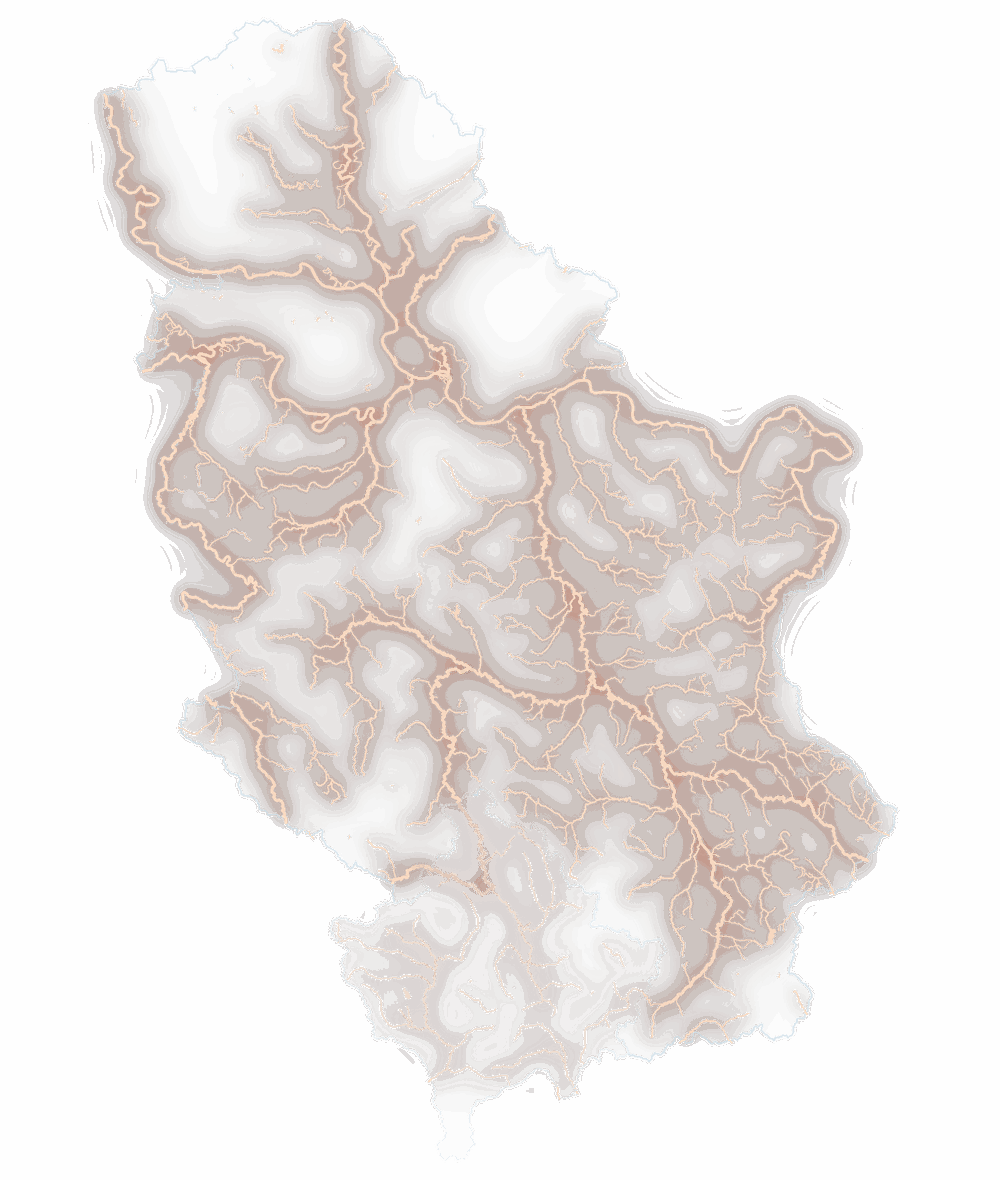
Since 4 November citizens have sent us 183 reports from their waters. In the media and official documents from 2016 to today we found another 183 cases. Together that is more than 350 problems recorded on Serbia's rivers and lakes; each event is counted once.
This is a preliminary report: it was put together quickly, to be read in two minutes, and we are still adding to it.
Signatures have come from all over Serbia, from Subotica in the north to Vranje in the south, from large cities and small villages.
Each circle is one city or municipality; a larger circle means more signatories (the legend gives the minimum number of signatories for each circle size). The map shows no names or individual signatures, only the total per city or municipality.The ten cities and municipalities with the most signatories
City or municipality
Signatories
Belgrade
6,565
Novi Sad
1,398
Pančevo
694
Kragujevac
518
Niš
515
Valjevo
439
Zrenjanin
337
Čačak
272
Užice
256
Šabac
233
Only signatories who entered their place (about 72%). As of the morning of 10 November.
About 72% of signatories entered their place, so the real figures per place are higher. The number of citizens and organisations shows the current state; the map and the number of places are from the morning of 10 November.
And they are writing to the minister
more than 1,030letters sent to Minister Sara Pavkov
Since 10 November, citizens have been using the “Write to the minister” page to send a letter from their own mailbox, in their own words, asking the minister to withdraw the public call.
We count clicks on “Send” on that page, once per browser. As of 12 November 2026, 19:15.
2
What people reported
Everything in this section is a claim made by citizens. We have not verified these claims in the field, and we do not publish the names of the people reporting or their descriptions.
In one week, from all over the country
183reports from 72 municipalities, 4 to 10 November
People wrote to us through the form and by email: what they saw on their river or lake, when, and whom they reported it to.
Claims by citizens, not verified in the field. We do not count empty reports, and we count each event once.
What people write about
Poaching50
Waters without wardens48
Fish kill or pollution40
Gravel extraction and riverbed works27
The main subject of each report. Another 18 reports are about other subjects. Of the 48 reports about waters without wardens, 22 come from districts that are now being handed over for ten years.
Claims by citizens, not verified in the field. The number of reports is not the number of waters: several people may write about the same one.
They reported it, and no one came
30 of 58reports that people say they also filed with the authorities
30: no one came or nothing was done
4: action was taken on the report
24: a written reply arrived, the case is pending or the outcome is unknown
In 58 reports people say they notified someone about the case. In 30 of them they say no one came, or nothing was done.
According to the people reporting; not verified in the field. In 14 of those 30 reports the case was reported only to the user's own fish warden, not to a state body.
It does not happen just once
3 of 4reports: “it goes on all the time”
Of 160 reports sent through the form120
In 120 of 160 reports sent through the form, people say that what they are reporting does not happen once, but all the time.
Claims by citizens, not verified in the field. Reports sent by email do not include this information.
3
What public sources and the state's own documents say
In the media and in documents
183cases from 2016 to today
Fish kills and pollution110
Gravel extraction and riverbed works33
Poaching20
Waters without wardens12
Other8
In the media and official documents we found 183 cases on rivers and lakes; 110 of them are fish kills and pollution.
For each case we have a link to the source. The list is not complete: we searched mainly in the districts covered by the call. We do not claim that fish kills are increasing, or that the users of the waters are responsible for them.
What follows is not our estimate and not citizen reports. These are figures the state publishes itself, each with a link to the document.
Fewer inspections every year since 2018
895 → 354inspections a year, in 2018 and 2025
The Fisheries Inspectorate of the Ministry of Environmental Protection carried out 895 inspections in 2018, and 354 in 2025.
The year links to the annual report of the Fisheries Inspectorate for that year (PDF, in Serbian). Asterisk: the report is no longer on the Ministry's website, so the link leads to a copy of that address saved in 2024 by the public internet archive web.archive.org. The number of inspections is from the summary table of each report; in the reports for 2017, 2021 and 2024 the text also gives a different figure. We counted fish kill locations from the list in each report; the report for 2021 has no list, and the reports do not record them in the same way every year, so we do not conclude from these figures that fish kills are increasing.
8 → 6 → 5people for all fishing waters outside Vojvodina
From 2017 to 2022 the inspection plan was drawn up for eight inspectors, and from 2023 for six. According to the plan for 2026, five civil servants will work in the unit from April.
In the same plan the Inspectorate itself writes that “the existing capacity of the fisheries inspectorate is insufficient”.
What the Inspectorate records about fish kills and users
20locations where fish died in 2025
13 of 13users of fishing districts: “negligible risk”
In its report for 2025 the Fisheries Inspectorate lists fish kills at 20 locations. In the same report it rates all 13 users of fishing districts (the organisations that manage them) as “negligible risk”.
The same rating appears in every report since 2019. In the report for 2018 one user was rated as critical risk and the other twelve as negligible.
Terminated contracts. From 2009 to today we have found one contract with a user that was terminated: the Ministry terminated it in 2015, and the dispute lasted until a Supreme Court judgment in 2024. Supreme Court, judgment Uzp 50/2023 (PDF, in Serbian)
The state has not published a list of terminated contracts, so we say only what we have found.
Monitoring covered a quarter of water bodies
24%of water bodies covered by monitoring, 2017–2019
The Environmental Protection Agency, which operates within the Ministry, states that from 2017 to 2019 ecological status was monitored in 24% of 504 surface water bodies.
more than 350problems recorded on Serbia's rivers and lakes
183 reports from citizens, 4 to 10 November 2026
183 cases from the media and official documents, 2016 to 2026
Each event is counted once. Citizen reports are claims that have not been verified in the field; cases from public sources link to the source.
That is why we ask Minister Sara Pavkov to withdraw the public call
Who decides. The government is in caretaker status and may only carry out day-to-day business. Handing over rivers for ten years is not day-to-day business.
On what basis. The call awards no points for how well each user has looked after the water so far.
There is an alternative. The law allows the waters to be entrusted temporarily until a new call is held, and the Ministry has annulled such a call before.
Where the data comes from. Signatures: the counter and the list on this site; places are those the signatories entered themselves. Citizen reports: the form at dojave.nasevode.rs and email, 4 to 10 November 2026. Public sources: media and official documents from 2016 to 2026. The figures on the work of the state are from the annual reports of the Fisheries Inspectorate, decisions of the Ministry, a Supreme Court judgment and a report by the Environmental Protection Agency; each has a link to the document, and all links were opened on 10 November 2026.
What has not been verified. Citizen reports are claims: we have not verified them in the field. The list of cases from public sources is not complete and is not a sample, because we searched mainly in the districts covered by the call. For that reason we do not compare districts with one another.
How we count. We keep citizen reports and cases from public sources separate. When we cite them together, we give both numbers and the period each refers to, and we count each event once.
How it was made. The overview was prepared with the help of artificial intelligence tools and is checked by people. If you find a mistake, write to us: [email protected].
When it was updated. The report was published on 10 November 2026, and the figures were updated on 12 November 2026 at 19:15. Citizen reports and cases from public sources were counted in our case database; it contains reports received up to 10 November, and we are still reviewing newer ones. Signatures and letters are as of the time of the update; the map of signatures and the number of places are from the morning of 10 November. Figures from state documents do not change.